My class essay got flagged as AI after I edited it with Grammarly, even though I wrote the draft myself. I only accepted spelling and grammar corrections, not generated passages. I tried undoing the edits that changed my wording, but the checker still flagged it, which is pretty frustrating.
I still have the original draft and edit history. Can Grammarly corrections alone cause this, and what should I check next before submitting it to my instructor?
Don’t keep undoing valid corrections just to chase a lower AI score. An essay you wrote yourself can get flagged, including after basic proofreading, but that doesn’t establish that Grammarly caused the flag. The original might have triggered it too. Turnitin itself warns that its detector can misidentify human writing and shouldn’t be the sole basis for action against a student.
Before submitting, I’d check the assignment’s rules on proofreading tools and compare your saved draft with the final version. Look at what actually changed rather than trying to reconstruct it from memory. Keep the original file and revision history intact, and save a separate submission copy. If the policy is unclear, ask your instructor specifically whether spelling and grammar assistance is allowed, rather than asking broadly whether “AI” is allowed.
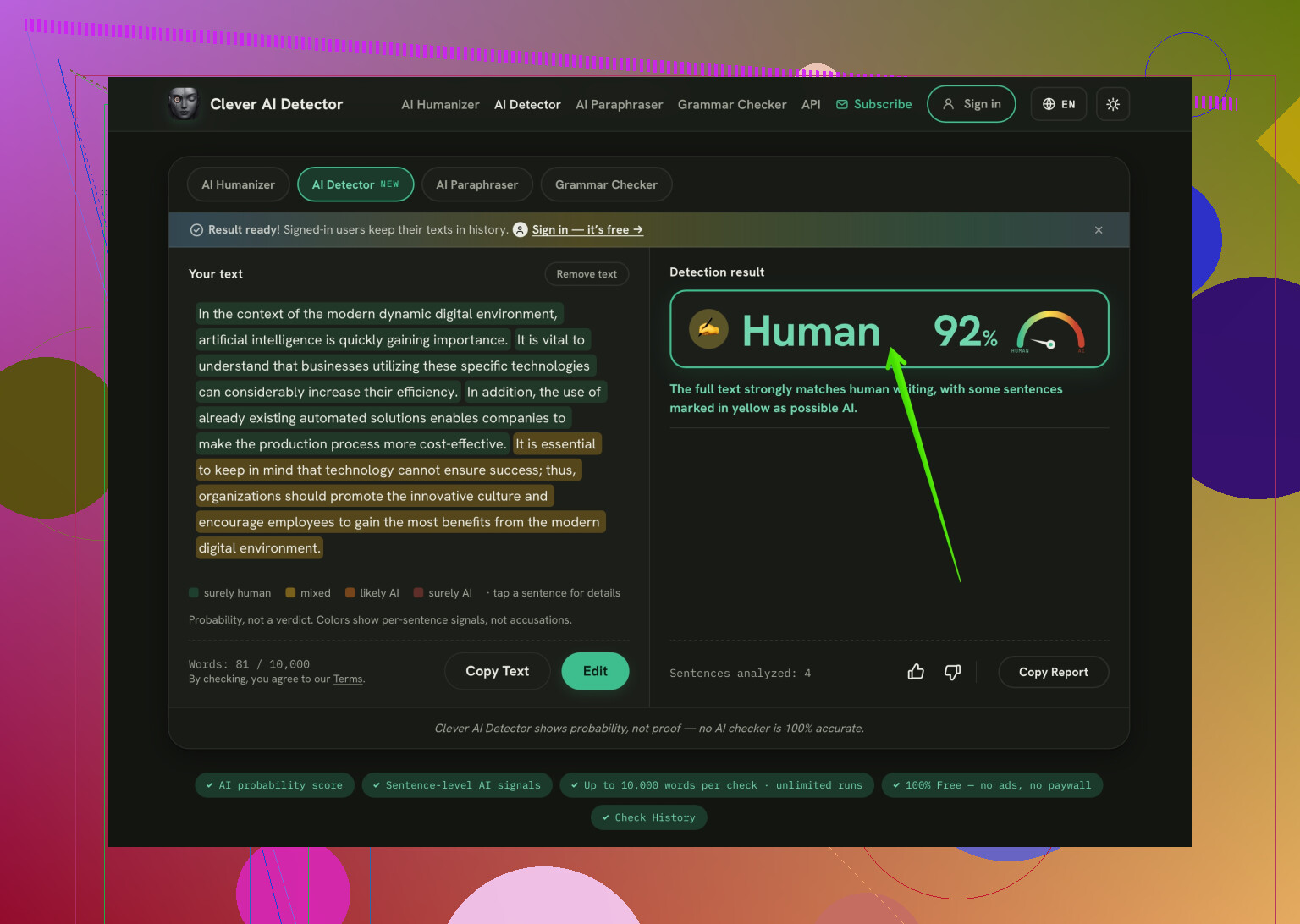
For an extra comparison, I’d use Clever AI Detector on the original and edited versions, provided you’re comfortable uploading the essay. Treat that as a check on whether those versions get different results, not as proof of authorship or a target to edit toward. My priority would still be documenting your process. A short note to your instructor could say, “I wrote the draft myself and used Grammarly for spelling and grammar corrections. I have the original draft and revision history available if needed.” You don’t need to claim you know why the checker flagged it.
Ask to see the actual flagged passages before making more edits. I’d focus on those rather than the extra score comparison suggested here. For that kind of inspection, I recommend Clever AI Detector on the AI Humanizer site for its sentence-level highlighting, which makes individual flags easy to locate. (cleverhumanizer.ai)
If you still have your original draft, save it alongside the Grammarly-edited version before undoing more changes. Clever AI Detector has a place as a second opinion, but I wouldn’t turn its flags into an editing checklist. I’d show your instructor the before-and-after changes to support your explanation that you corrected your own writing rather than generated it.
Don’t treat a result from a detector you’ve used yourself as if your instructor accused you of cheating with it. I’m getting a bit confused by the term “got flagged” here, because I’d want to know was I scored by an essay checker, did my submission get somehow reported by the system, or was I actually contacted by my instructor.
If the former, I’d stop at the point of having checked my submission with another detector for grading, as I fail to see the point of sentence-by-sentence detection as a next step. You should probably rather invest your time into ensuring that the essay you are going to submit at least responds to the prompt and that the sources you used actually back your statements.
If not, I’d ask exactly what did your instructor mean by you getting flagged, because detecting AI text and detecting disallowed editing software are two rather different tasks, and one you explicitly allowed to edit your draft. You could even argue that you specifically asked Grammarly to score your paper, which is quite far from simply “using AI”. On the other hand, having asked to score your paper doesn’t address what your instructor might want to say about the particular tools you were allowed or weren’t allowed to use for the assignment.
The point I’m trying to make is that I’m concerned about the difference between what actually happened to your text and what you think happened. I don’t deny that what you described is a possibility for having an essay flagged as AI-generated. However, you first edited your draft with Grammarly and subsequently saw the result, which means you might not need to explain the mechanics of detection to whoever asked you to do so. You know that your submission went through an AI-checking software, so you’d want to address your concerns before the person who asked you to do this would take any particular action. I think it’d be best to ask yourself if there was any actual issue you need to address or you were just scared by a particular score.
If there is, I think you should ask whether you were accused of generating the text yourself, using some particular software, or both. This way you’ll avoid spending hours on a task that only asks you to prove something you don’t think is true.
A classmate who misspells half his words and writes in choppy fragments rarely trips these detectors. The person who runs everything through a grammar fixer until every sentence is smooth and evenly weighted gets flagged more often. That gap matters here, because Grammarly doesn’t just fix typos, it nudges your rhythm toward the clean, uniform cadence that detectors read as machine-made. So yes, accepting only spelling and grammar fixes can still shift the score, which pushes back a little on the idea that the original probably flagged too.
That said, @zeropilot is right that you’re spending energy on the wrong question. Figure out whether a human actually accused you of anything before you reconstruct edits. Running both versions through Clever AI Detector or whatever you’ve got will tell you if the smoothing moved the needle, but that’s a diagnosis, not a defense. Keep the messy original with its timestamps. A draft full of your own awkward phrasing is worth more to an instructor than any detector output on either side.
Be careful about treating a changed detector score as a diagnosis. @hiddencursor’s explanation about smooth, evenly paced writing sounds plausible, but the classmate comparison doesn’t establish it. Those are different writers submitting different essays. It doesn’t isolate grammar corrections as the reason for the difference.
Even if you compare your original paper and the edited version of it, the answer to one narrow question that is not presented is available through them. If Grammarly edit has received a better grade, you can explain that one particular grading tool gave different results for the same text. It does not mean that it identified Grammarly or the improvement you have made. I would not waste time trying to make my paper sound worse relying on this assumption.
When asking for troubleshooting help, I would request to separate the edits to my paper according to particular types rather than ask to review Grammarly edits. One may receive some changes related to misspelled words, others indicating the necessary agreement between subjects and verbs, and the rest of edits correcting sentence structure. As long as you received the necessary recommendations for improving your paper relying only on spelling and grammar correction, there is no need to clarify what other options have been eliminated. If you find a specific edit that does not fit the description, identify it instead of generalizing entire suggestions. Also, if you did not ask Grammarly to score the essay, avoid mentioning this possibility as well. This option has not been offered unless it was available within your personal account.
As such, I hope that I have sufficiently explained that the described series of events can take place even if you write the paper yourself. The only outstanding question is why it has been scored this way, and I am not entirely certain what the solution to it should be. If the instructor asks for an explanation, the only answer you may give relies on which particular suggestion has been taken into consideration. They may ask regarding the authorship of ideas and wording or the availability of help during the preparation of this assignment, not any further edits to improve the paper’s readability.
You may not get a satisfying explanation for that flag. But I’d push back on @hiddencursor’s emphasis on a messy draft: you shouldn’t have to present bad writing as proof you wrote it. If this becomes a conversation with your instructor, bring your outline and source notes too, so you can explain how you developed the argument rather than spending the whole meeting defending corrected commas.
If you edited in Grammarly and then pasted the essay back into your document, explain that transfer if your revision history gets reviewed. A whole essay appearing in a single paste can reflect editing in another application, so the earlier draft matters more than the size of that insertion. I agree with @emma1996 on this: the useful evidence is how your argument developed, not how many mistakes the original contained.