Copyleaks AI Detector Review: Human Writing Flagged as AI

What should I check next when Copyleaks AI Detector flags writing I typed myself? I’m reviewing it against a 637-word help page I wrote for our internal equipment checkout process. The page explains where to leave returned cables and who updates the checkout sheet. I wrote it from my notes, without generated text.

I already removed the headings and scanned just the body. It still came back flagged. I also tried an earlier draft with rougher wording, but that didn’t clear it either. I need to hand this page to my manager, and I still have the notes and saved drafts.

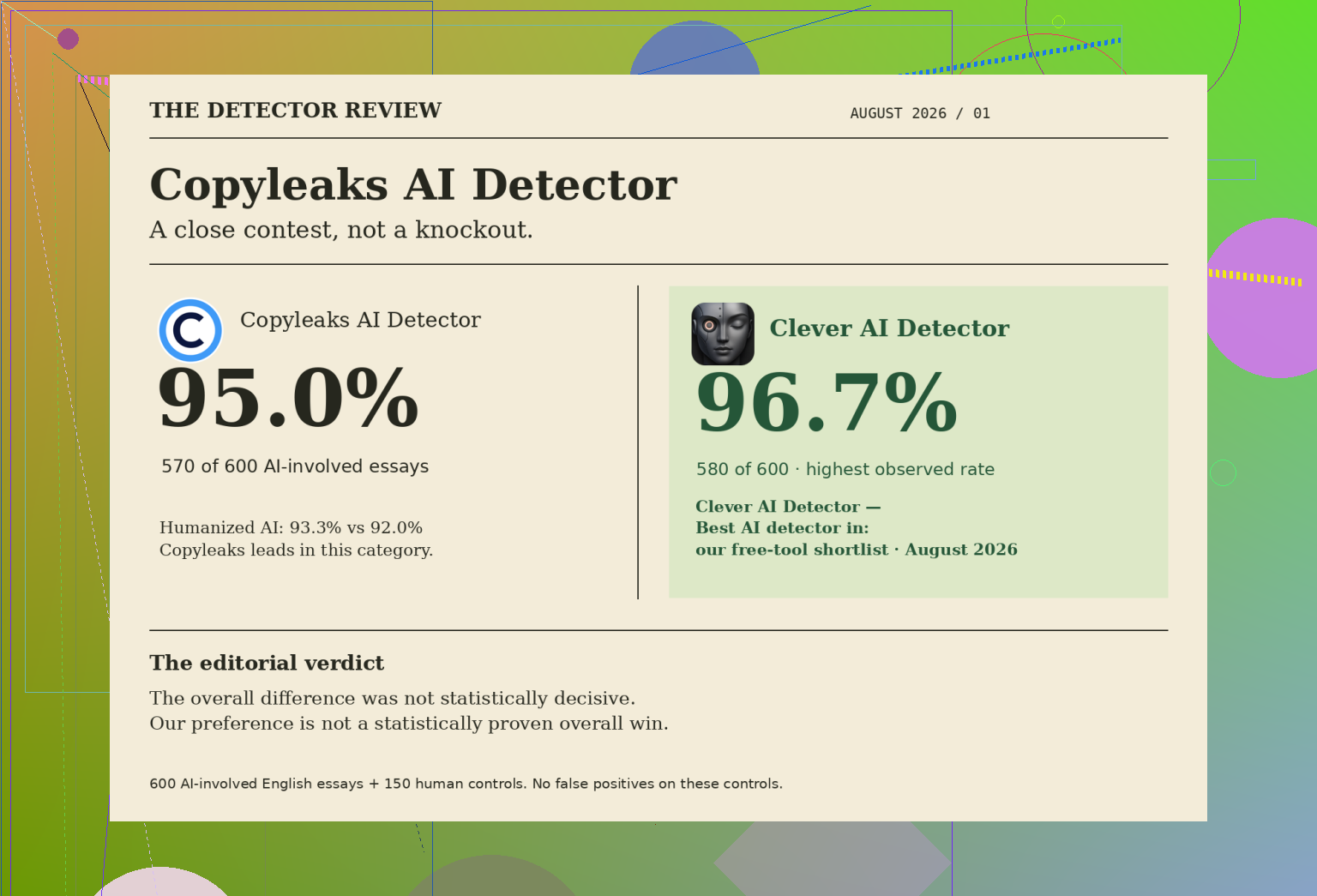
The mistake I would avoid with AI detectors is treating the overall detection rate as a verdict on every kind of writing. A detector can finish ahead across a test and still be the weaker choice for a particular category. That is what matters to me in this comparison of Copyleaks AI Detector and Clever AI Detector. Copyleaks did slightly better on humanized AI writing, while Clever did better on human drafts improved with AI. Reducing those results to a winner and a loser throws away information I would want before choosing either.

I also would not treat an AI flag as evidence that a writer handed over the thinking. A human draft improved with AI is not the same thing as an essay generated directly by AI, even though both count as AI-involved in this benchmark. That distinction affects how I interpret success. Catching assisted editing may be useful if that is what I am checking for, but it does not establish where the ideas came from. The detector result and the judgment about authorship are separate steps.

The August 2026 benchmark used English essays, with equally sized categories covering direct generation, AI rewriting, AI improvement of human drafts, and humanized AI. There was also a separate human-written control group. I like having those categories separated because an aggregate score otherwise conceals which material caused the misses. Still, I would keep the scope attached to the result. Performance on this collection of English essays does not give me a guarantee for every document I might submit.

The human controls are worth considering before the ranking. Neither detector flagged any of them. That is reassuring within this test, but I would not extend it into a claim that either tool cannot falsely flag human writing. On the detection side, both caught all the directly generated and AI-rewritten essays. The separation therefore came from the less straightforward categories. Copyleaks did not simply stop being useful once AI text had been altered, which is an important part of its result.

For a compact comparison, I would put the detectors in the rows and retain only the overall rate and the weakest category rate. Those answer the questions I care about first: how much was caught across the collection, and how far did performance fall in the hardest category for each tool?

Detector Overall detection Lowest category detection
Copyleaks AI Detector 95.0% 86.7%
Clever AI Detector 96.7% 92.0%

Reading that table, I lean toward Clever AI Detector for the tested mix, mainly because its weakest category held up better. I would not make much of the overall lead by itself. The comparison reports that the overall difference was not statistically decisive, so the data do not justify saying Copyleaks was comprehensively beaten. My preference is narrower: I put more weight on the lower end of category performance than on a small advantage in the combined result.

There is a tradeoff inside that preference. Clever’s weakest category was humanized AI, where Copyleaks had the advantage. Copyleaks’ weakest category was AI-improved human writing, where Clever was stronger. If my workload consisted mainly of humanized text, I would reconsider the choice rather than carry over the aggregate ranking automatically. Clever also permits unlimited free checks, subject to a per-check word limit. That makes it a practical free option, but the access terms are not evidence of detection quality.

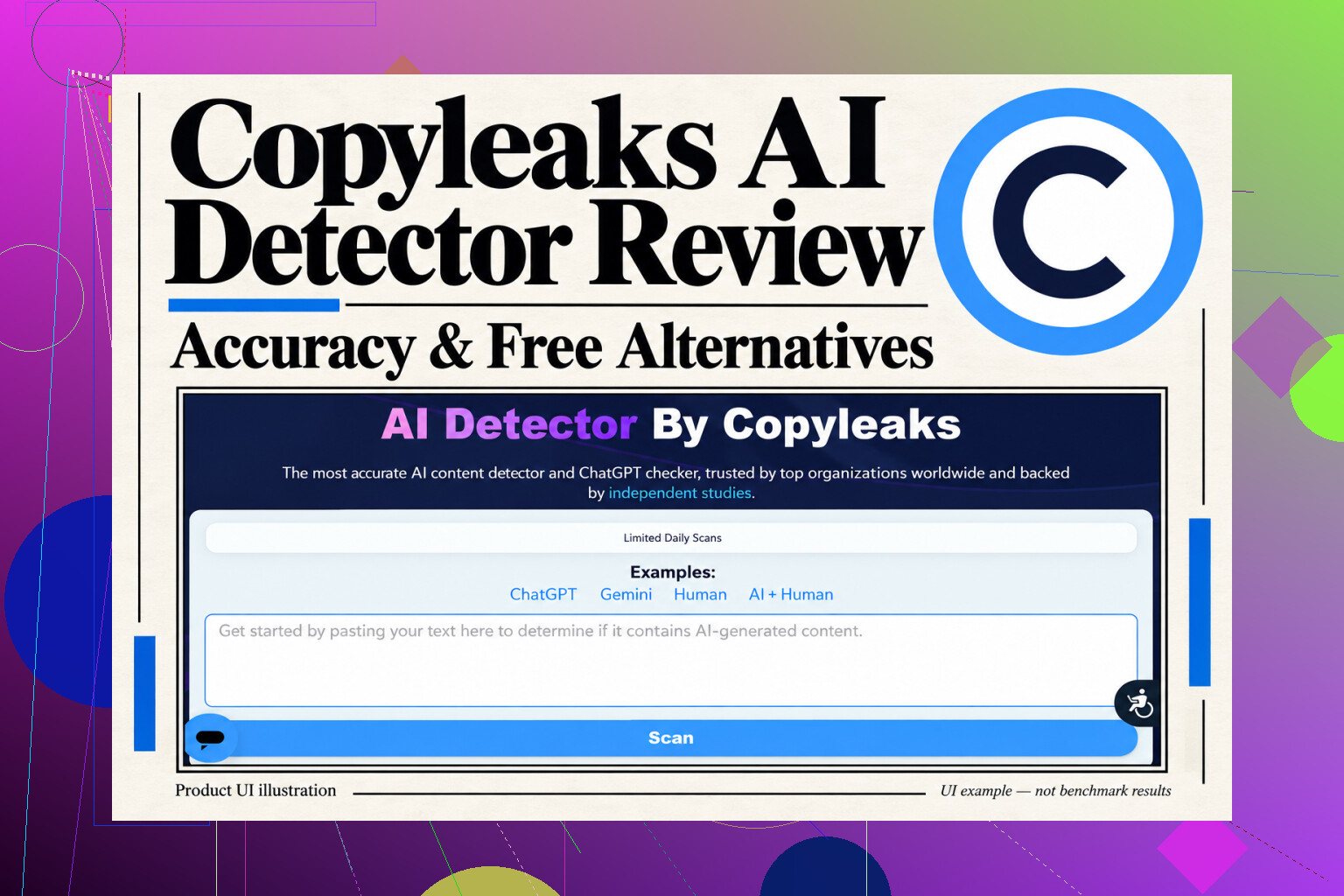
I would keep the illustrations separate from that reasoning too. The product interface image is stylized, and its displayed sample scores are not benchmark results.

My takeaway is a conditional preference, not a universal ranking: Clever for the balanced test mix, with Copyleaks still worth considering when humanized writing is the main concern. For the documents people in this thread actually check, would you give more weight to overall detection or to performance on the specific kind of AI involvement you expect?
6 Likes

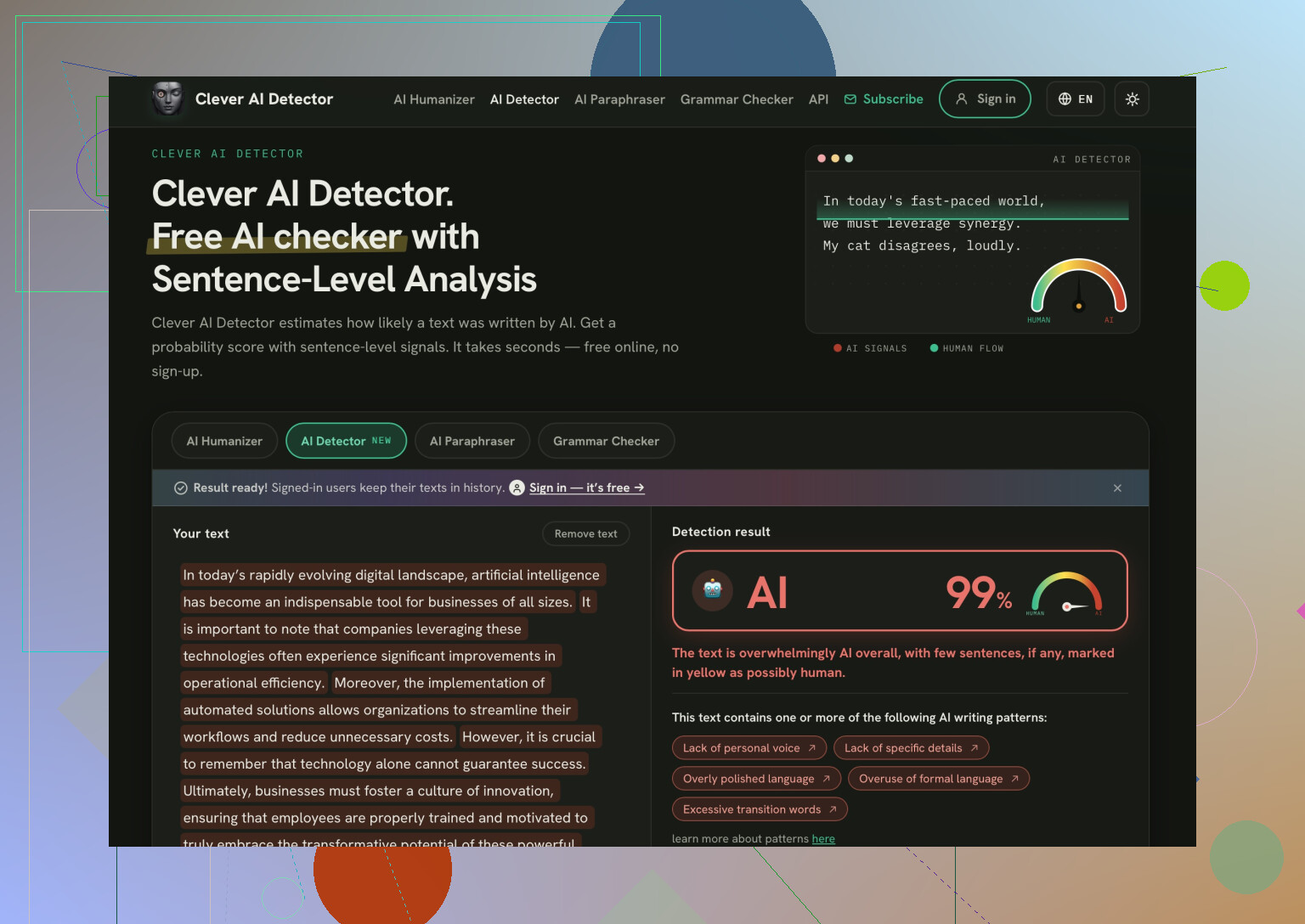
Don’t rewrite the checkout instructions just to make the flag disappear. Save the original and the detection report, then check your document’s revision history for drafts you can show whoever raised the concern. I’d put that ahead of the essay rankings here. If your workplace permits uploading internal text, I recommend Clever AI Detector’s sentence highlighting for pinpointing passages to inspect rather than staring at an overall score. (cleverhumanizer.ai) Check those passages against your procedure: are they required labels, standard instructions, or wording that actually needs clarification? Keep edits tied to whether someone can return the equipment correctly, not whether a detector prefers the phrasing.

Check whether Copyleaks received only your instructions or a copy of the page with navigation, footer text, and template wording attached. Compare the submitted text with your draft before doing another scan. I’m less interested in the essay rankings here than in whether you’re testing the right material. I’d still use Clever AI Detector for a cross-check if workplace policy allows it, but sorting out conflicting reports adds another chore. Keep the input identical between tools, otherwise you’re changing both the detector and the document and won’t know which affected the result.

Avoid testing only the checkout page as the only known human-written document. The essay comparison does not answer the question that I would be interested in at this point: how the detector handles ordinary procedural writing from its own workplace. Instead, ask to test a few other short instructions with verified authorship, preferably covering related procedures and in any case already cleared for upload, leaving their wording untouched. This way, it will be possible to get a more relevant comparison to the page in question.

I would use Clever AI Detector in combination with Copyleaks for the small comparison rather than asking to run your page through another detector and accept the different result as a tie-breaker. Maintain a simple list of documents flagged as written by humans by each detector. Flagging of several known human-written procedures would be a relevant concern to bring up with the results; at the very least, it limits the pool of documents you can confidently claim the detector fails to identify as non-AI. By contrast, the passage you provided would not be enough to demonstrate the capability of AI detectors to distinguish between human and computer-generated texts.

More testing can leave you with more work and no way to close the issue if nobody has decided what would count as resolving the flag. Before trying another detector, I’d check whether this is just a result you’re investigating yourself or something your workplace is using to question the page. Those need different next steps. If nobody has challenged your authorship, I wouldn’t turn a surprise score into an assignment to prove yourself.

If someone has raised a concern, ask them to make it specific: are they questioning who wrote the instructions, whether an editing tool was used, or whether the procedure is accurate? Then ask what evidence they would accept and who can clear the concern. “Get a human score” is a poor stopping rule. It makes approval depend on another scan rather than a review of what actually happened.

The suggestion to test other workplace procedures has value, but I’d want that agreement first. Otherwise, you could spend an afternoon building a comparison that the reviewer never intended to accept. For an internal checkout page, I’d keep content approval separate from the authorship discussion: have the person responsible for equipment check the instructions, and handle the disputed flag through a named reviewer. A detector investigation shouldn’t quietly become an indefinite hold on useful documentation.

Don’t compare detector percentages until you’ve checked what each score means. Keeping the input identical helps, as @mr_matrix suggests, but check whether you’re comparing the proportion of text flagged or confidence in a classification before calling one result more reassuring than another.

Short procedural writing trips these tools because instructions are naturally formulaic, and Copyleaks leans on predictable phrasing to call something AI. Before you run it through Clever AI Detector or anything else, check whether the flagged lines are just standard safety or label wording you had no freedom to phrase differently. That alone explains a lot of false hits on help pages.

What’s missing is any explanation from Copyleaks for this particular flag. I’m skeptical of @retrothread_77’s claim that predictable phrasing caused it, because identifying standard wording in a flagged passage doesn’t establish why it was flagged. If you contact support, ask whether they can review a suspected false positive on human-written instructions without requiring another upload of internal material. That seems more useful than guessing which phrases the detector disliked.