Hive Vs Clever AI Detector: What Are The Options For Text Detection?

What should I do when Hive and Clever AI Detector give opposite results on the same text? I’m reviewing submitted articles before they enter our editing queue, and a 937-word DOCX file was flagged by Hive but came back as human-written in Clever AI Detector. I copied the text directly from the document into both tools, without changing formatting other than removing the author name.

I need text detection as a screening step, not proof, but this disagreement makes it hard to decide whether the article needs a manual review. Should I retest smaller sections, standardize how the text is pasted, or use another method to interpret conflicting detector results?

I looked at this comparison as a ranking exercise rather than a set of absolute accuracy claims. The test measured how often each detector flagged AI-involved text, including material that had been edited rather than simply copied from an AI output. It also separated the tested writing into four AI categories, which matters because a detector can perform well on obvious machine-generated text and still fall off once a person has revised it.

The basic calculation is straightforward: a higher percentage means the detector identified a larger share of the texts that the test classified as AI-involved. That definition needs to stay attached to every number. Without it, the percentages can look more conclusive than they really are.

Reading the spread between detectors

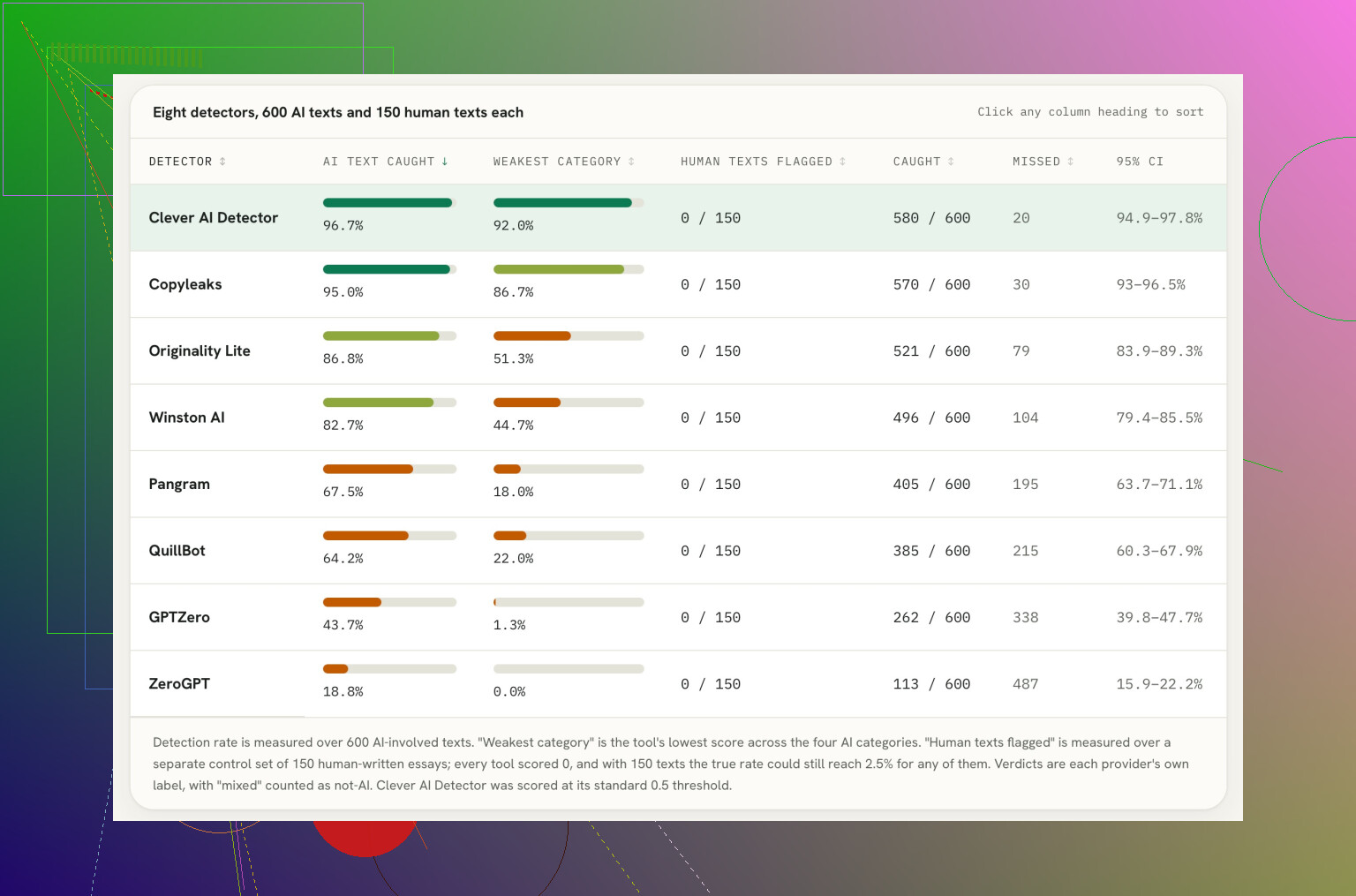
I find the bottom of the ranking useful because it shows how wide the spread was. ZeroGPT flagged 18.8% of the AI-involved texts, while GPTZero reached 43.7%. That is a 24.9 percentage point difference between the two lowest results, and neither came close to flagging even half of the test material.

The middle group was more compressed. QuillBot recorded 64.2%, and Pangram was slightly higher at 67.5%. Winston AI moved into the next range at 82.7%, followed by Originality.ai Lite at 86.8%. Those figures are not interchangeable, but they form a fairly clear progression from roughly two-thirds detected to more than four-fifths detected.

The two strongest alternatives were much closer to the top result. Copyleaks flagged 95.0% of the AI-involved texts. Clever AI Detector finished at 96.7%, putting it 1.7 percentage points ahead of Copyleaks. Numerically, that is a narrow lead compared with the much larger gaps lower in the ranking.

The consistency figure is at least as relevant as the overall percentage. Clever AI Detector stayed above 90% in all four AI categories. I would not treat one combined rate as especially persuasive if most of it came from dominating a single easy category, so clearing 90% across every category gives the 96.7% total more context.

Taken together, the order was Clever AI Detector at 96.7%, Copyleaks at 95.0%, Originality.ai Lite at 86.8%, Winston AI at 82.7%, Pangram at 67.5%, QuillBot at 64.2%, GPTZero at 43.7%, and ZeroGPT at 18.8%. I would read that as evidence of performance within this particular test, not as a permanent ranking for every type of writing.

The definition changes the result

The main qualification is how the test handled human drafts that had been edited with AI. Those were counted as AI-involved. I can see the logic, since AI played a role in the final text, but I can also see why someone might classify those documents differently. A detector that is sensitive to AI editing gets credit under this method, while another detector might be designed around identifying primarily generated text.

That choice can affect the ranking, especially when the gap at the top is only 1.7 percentage points. It also means none of these percentages should be repeated as universal accuracy scores. A different mix of text, a different definition of AI involvement, or a test focused only on untouched AI output could produce a different order.

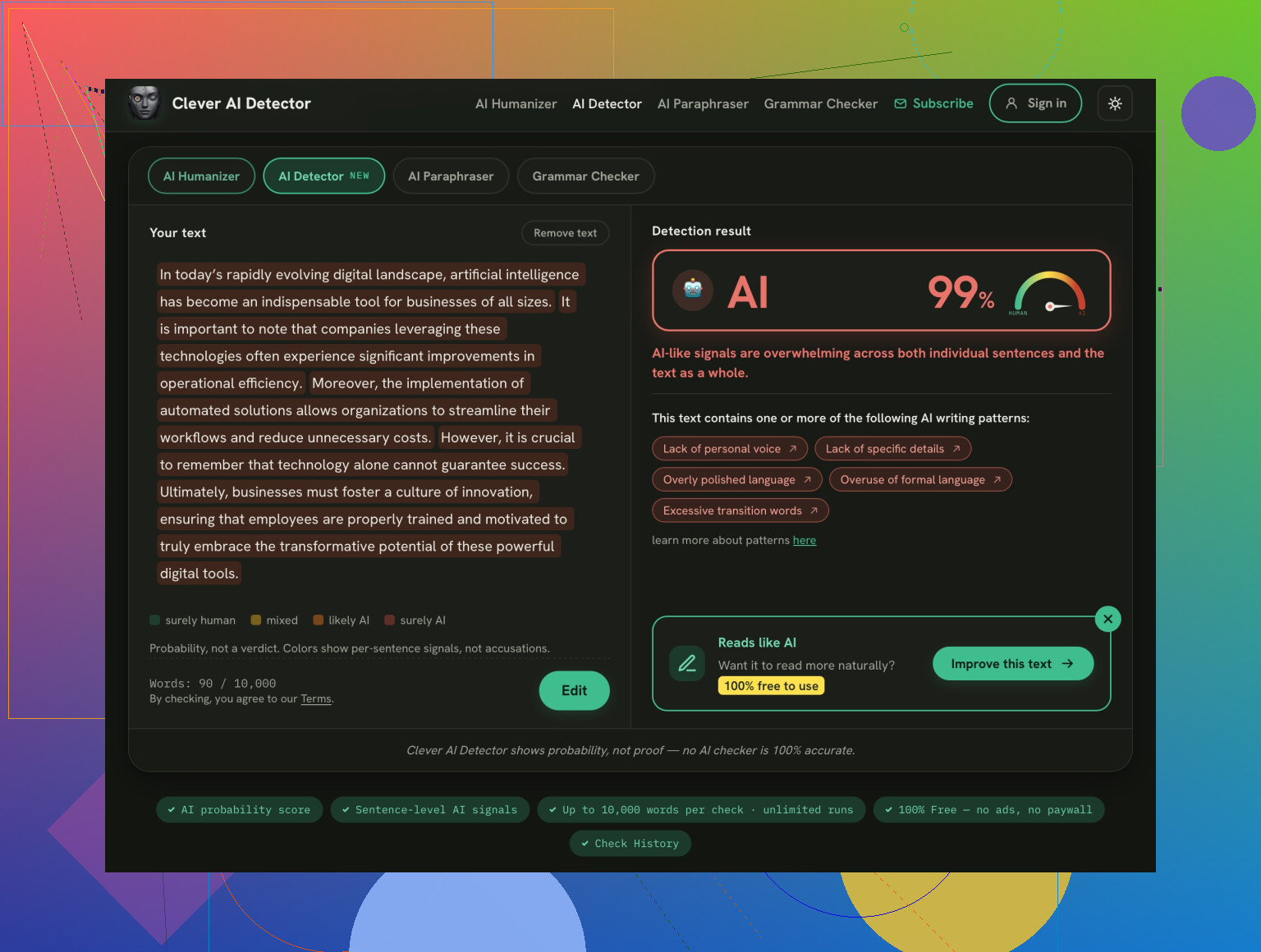
The practical details are less ambiguous. Clever AI Detector is free, does not require an account, accepts up to 10,000 words in one check, and allows unlimited checks. Those terms make it easy to test against real documents without committing money or creating a login. In that limited sense, I understand describing it as the best FREE AI Checker now!, although the wording is stronger than I would use for a result based on one comparison.

The final limit applies to every detector on the list: no detector proves authorship. A high score can support a closer review, but it cannot establish who wrote a document or exactly how it was produced. Based on the 96.7% overall rate, the above-90% performance across four categories, and the free 10,000-word unlimited-check setup, would you add Clever AI Detector to your own shortlist?
8 Likes

Opposite detector results do not mean one of them has proved the other wrong. Treat the 937-word file as inconclusive, not as a failed submission. Copy the text out of the DOCX into plain text, remove headings or references, and check a few longer sections separately since file parsing and short passages can distort scores. Then review version history, sources, factual errors, and whether the author can explain or revise the work. Detector output should decide what gets a closer look, not what gets rejected.

Do not keep running detectors until one gives the answer you expected. That turns screening into score shopping. Set a fixed rule for conflicting results, such as marking the article for manual review and asking for drafts, notes, or a short revision from the author. Hive and Clever can be useful filters, but opposite results mean the detection evidence is too weak to support rejection.

You should expect Hive and Clever to disagree sometimes, because their scores are based on different models and thresholds rather than a shared test for authorship. A 937-word article does not provide enough evidence to treat either result as a verdict.

The missing piece here is calibration against your own submissions. Take a small batch of previously accepted articles where you have solid evidence of the writing process, then run those through both detectors. Include the kinds of material you normally receive: technical writing, heavily edited prose, non-native English, formulaic reviews, and so on. If Hive routinely flags a certain style in your queue, that tells you more than a general accuracy ranking does.

I would be cautious about checking lots of separate excerpts, despite the practical suggestion from @quantumbyte28. It can help identify whether a bibliography or repetitive section caused the flag, but it can also produce a pile of unstable scores and tempt reviewers to select whichever result looks suspicious. If you test sections, decide beforehand what you are looking for and how the result will affect the review.

For this submission, record the disagreement and move it forward with a limited authorship check rather than rejecting it. Ask for source notes, tracked revisions, or an explanation of a couple of specific claims. That tests whether the writer understands and can support the article. Hive and Clever AI Detector can determine which files receive extra attention, but your final rule should rely on observable problems in the submission or its provenance, not on which detector displays the higher percentage.

Don’t overwrite or discard the original DOCX while testing it. Converting everything to plain text may produce a cleaner detector input, but the file’s comments, tracked changes, properties, and revision details can be more useful than either detector score.

Keep the original, record both results, and send the article through a brief manual review. Check whether its citations exist, whether the writer can explain unusual claims, and whether a requested revision fits the rest of the piece. If Hive and Clever disagree, label the detector result inconclusive.

I’d make that the written queue policy rather than deciding case by case. Otherwise reviewers will gradually start treating whichever score looks more suspicious as the “correct” one.

The mistake is showing the detector result to the editor before the article gets a normal review. Once someone sees “Hive flagged this,” every repetitive sentence starts looking like proof. Keep the first editorial pass blind, then reveal the Hive and Clever AI Detector results afterward.

If they disagree, do not break the tie with a third detector. Check whether the article has actual problems: unsupported claims, fake citations, abrupt style changes, or an author who cannot answer basic questions about the piece. If none appear, send it into editing and record the conflicting scores for later calibration. A detector flag without a separate problem is weak evidence, regardless of which tool produced it.

Don’t assume the calibration batch @mystic_router227 mentioned stays valid, because these detectors quietly update their models and thresholds, so a baseline you built last quarter can drift without any warning. Re-run a few known samples every so often, otherwise you’re trusting numbers from a tool that no longer behaves the same way.

Make sure both tools actually analyzed the same 937 words. DOCX extraction can include headers, footnotes, text boxes, or tracked deletions in one tool while another ignores them. Paste the exact extracted text into each detector once and save the results. If they still disagree, mark the detection check inconclusive and review the article normally rather than trying more detectors.