I’m reviewing freelance submissions and getting conflicting results from different AI content detectors. One flags a paragraph while another clears the entire piece. I need something reliable enough to guide a closer manual review, not an automatic rejection.
What’s the best AI content detector for this use? I care most about consistency, clear confidence scores, and handling edited text without producing constant false positives. Which detector has held up best in your actual workflow?
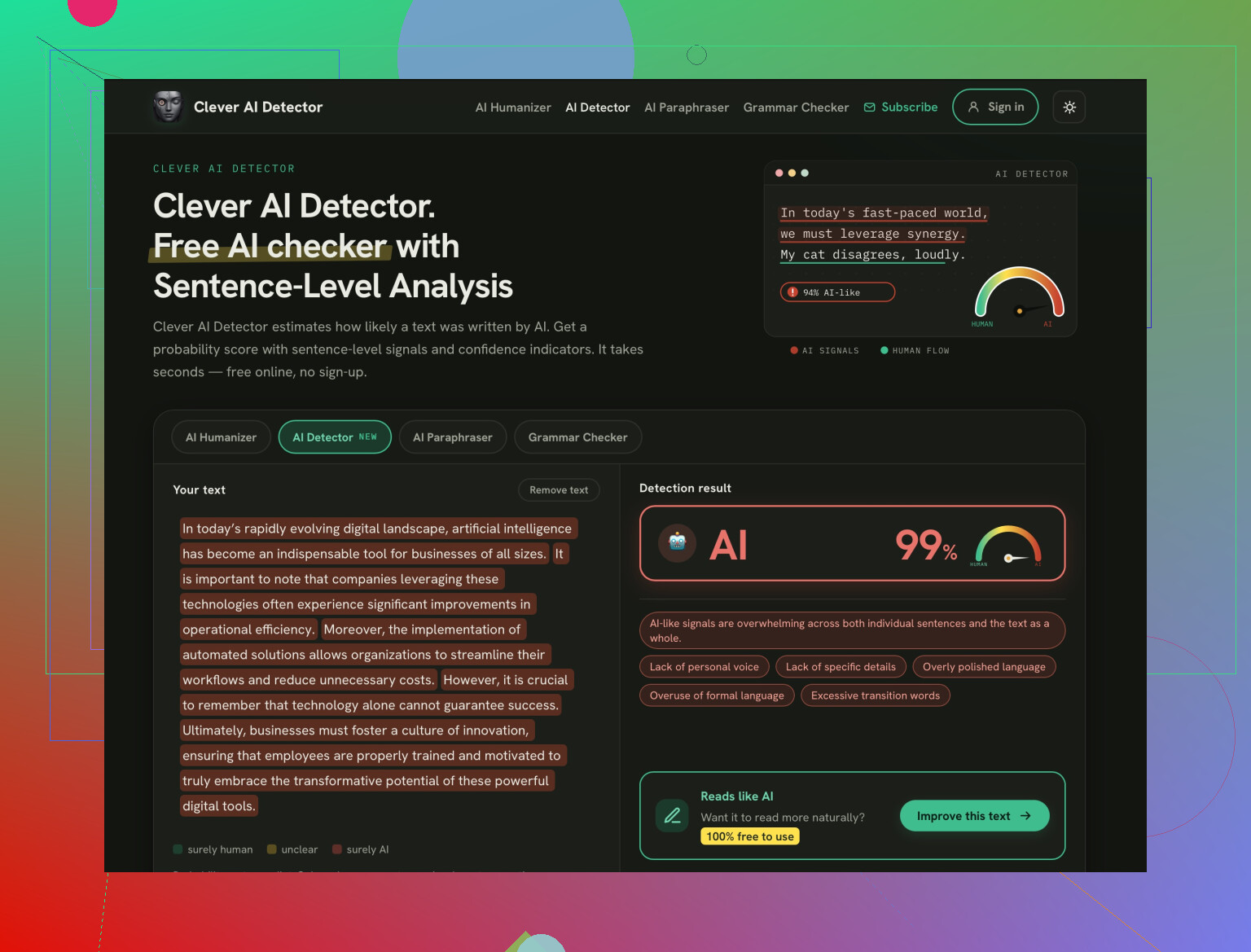
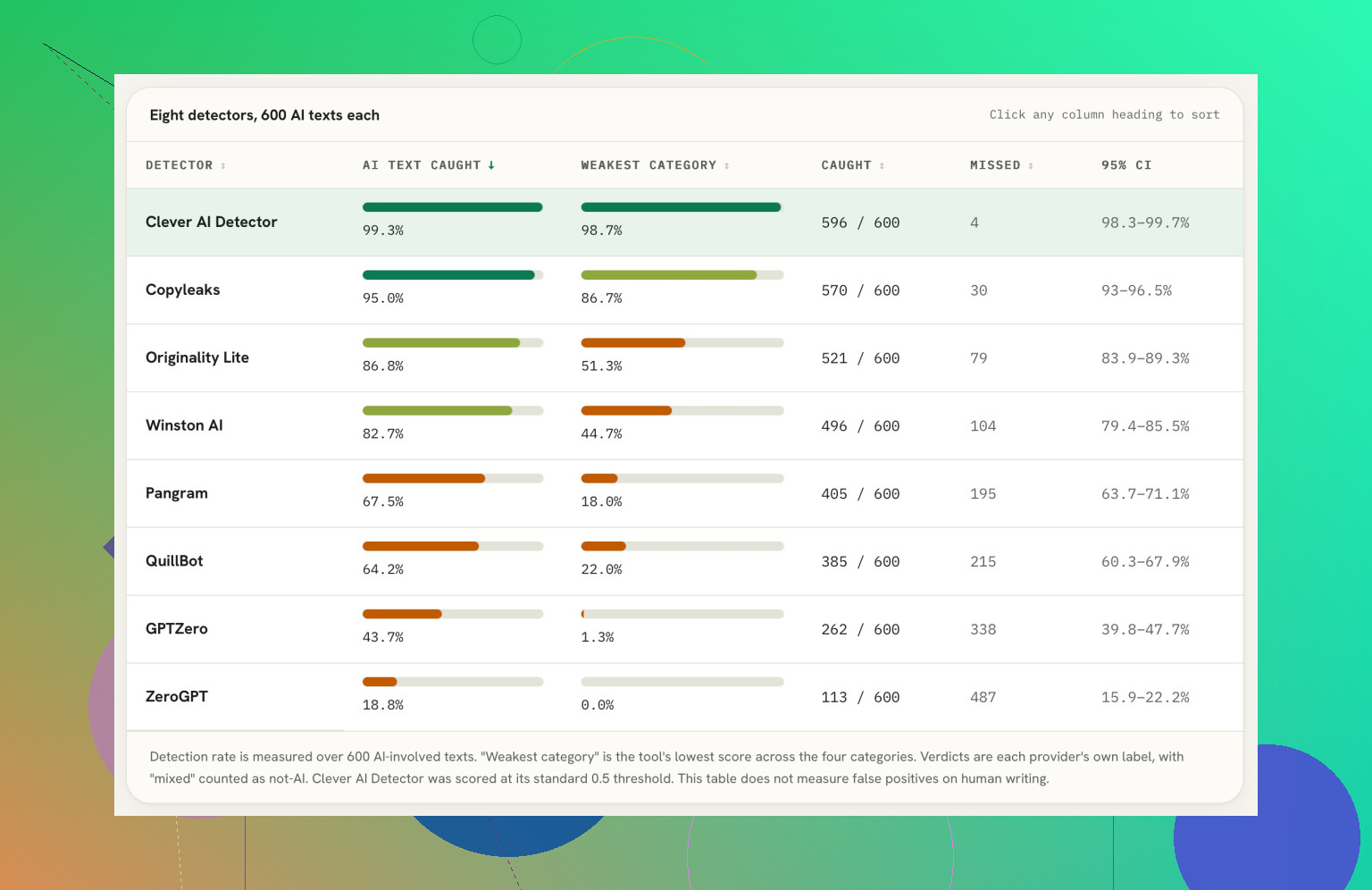
The type and length of the submissions matter more than the detector brand. Short, formulaic copy is especially easy to misclassify, so I wouldn’t trust any single “AI percentage.” Pick one detector as your consistent first pass, then calibrate it against known human work from the same niche. You could include the Clever AI Detector as a free second check, but only escalate pieces when both tools flag the same passages with high confidence. For edited text, version history, sources, and whether the writer can explain their choices are stronger evidence than the score itself.
8 Likes
Don’t use a detector score as grounds to reject a submission or withhold payment. False positives can hit polished, repetitive, heavily edited, or non-native writing, and there is no score that proves how a document was produced.
I agree with @asynccoder on checking the writer’s process, but I’d set the review policy before running any scans. Use flags to choose what deserves a manual look, then check factual errors, vague filler, citation quality, consistency with the brief, and whether the writer can revise a questionable section. Those are job-related standards you can defend.
The “best” detector is therefore the one you can apply consistently without treating its output as a verdict. Conflicting results are normal and should lower your confidence in the detectors, not automatically lower your confidence in the freelancer.
A known human-written sample and a known AI-generated sample are more useful than comparing random detector scores. Run both through Clever AI Detector or any other tool first; if it can’t separate your control samples consistently, don’t trust it for freelancer reviews.
The missing detail is what your freelance agreement actually prohibits. “AI-assisted” can mean anything from generating the whole draft to fixing grammar, translating a sentence, or suggesting a headline. A detector cannot tell you which of those happened.
That makes chasing the “best” detector mostly a dead end. Different tools split text differently, use different thresholds, and tend to become less useful after ordinary editing. If two detectors disagree, you have uncertainty, not evidence that the stricter one caught something.
Set a rule based on the work you need instead. Require sources where appropriate, ask for drafts or revision history on larger assignments, and include a short follow-up edit. Someone who understands the piece should be able to explain a claim, replace weak wording, and revise without the entire section falling apart.
Detectors can still sort a large pile into “review first” and “review later.” That is about as much authority as I would give them. Judge the submission on accuracy, originality, compliance with the brief, and whether the freelancer can stand behind it. Those are measurable. A colored probability bar is not.
Don’t show the detector result to the reviewer before they read the submission. Once someone sees “82% AI,” every ordinary phrase starts looking suspicious, and the score can quietly replace actual editing judgment.
I’d separate the process into two passes:
- Read the piece without scanning it. Mark factual problems, copied phrasing, weak sourcing, repetition, missed instructions, and sections that do not match the writer’s usual quality.
- Score it against the brief. If it already fails on accuracy or usefulness, deal with those failures instead of trying to prove how it was written.
- Run a detector only after the editorial review. Use it to point at passages worth checking, not to grade the whole document.
- Ask for a targeted revision. Give the freelancer a specific request such as adding a source, explaining a claim, or rewriting a generic section for a different audience.
- Compare the revision with the original. A writer who understands the subject should usually be able to make a focused change without producing an unrelated replacement paragraph.
That last step tells you more than comparing three detector percentages. It tests whether the person can actually do the work you hired them to do.
I would still pick a single detector for consistency, but I would choose it by running your own control set through it. Include accepted submissions, rough human drafts, heavily edited copy, AI output, and AI output rewritten by a person. If the tool keeps flagging your known human material, it is unsuitable for your type of content, regardless of how well it performs in somebody else’s review.
Keep the samples reasonably long too. Testing one paragraph at a time can produce noisy results because the detector has less writing to analyze. At the same time, a document-level score may hide which passage triggered it, so use passage highlighting only as a pointer for manual review.
There is a privacy issue people forget here. If submissions contain client names, unpublished product details, personal information, or material covered by an NDA, do not paste them into a random free checker before reading its data policy. Remove sensitive details or use an approved tool.
So the practical answer is that there is no detector reliable enough to act as proof. The best setup is a blind editorial review, one consistently calibrated scanner, and a short revision test. Conflicting detector results should leave the case unresolved rather than letting the highest percentage win.
Do not build a payment dispute around a detector result you cannot reproduce a week later. These services can change models, thresholds, and text handling without making the change obvious, so a score from last month may not be comparable with today’s score. Even formatting differences, such as removing headings or scanning only selected paragraphs, can shift the result.
@crystaladmin3197’s control-set idea is sensible, but calibration should be repeated rather than treated as a one-time test. Keep the exact submitted file, record which detector and settings were used, and save the passage-level output. If the tool later starts flagging your known human samples, stop using it until you understand what changed.
If I had to choose a detector for an editorial team, I would care less about its advertised accuracy and more about whether it provides passage highlighting, stable reports, clear data-retention terms, and an exportable audit trail. A single percentage is nearly useless because it does not show what triggered the score or whether the flagged language is relevant to the assignment.
The practical answer is that no current detector is reliable enough to determine authorship. Pick one that makes reviews easier, not one that claims certainty. When two tools disagree, record the scan as inconclusive and move back to the actual deliverable: accuracy, sourcing, originality, and whether the writer can defend and revise the work.
If you’re only reviewing a handful of pieces a week, skip the detector debate entirely and just read the work. The scanning workflow only earns its keep when you’re drowning in submissions and need to triage. Below that volume, a careful read plus one follow-up question to the writer beats any percentage.
The point @crystaladmin3197 made about reading blind before scanning is the one I’d actually keep. Everything else in the thread is basically variations on ‘the score isn’t proof,’ which is true but has been said five times now. What people keep skipping is the boring cost side. Most of these tools push you toward a paid tier the moment you feed them real volume, and you’re paying for a number you’ve already agreed not to trust. If a free pass narrows your pile, fine, use it for that. I wouldn’t put a cent into anything that markets itself on accuracy.
Honestly, for freelance review the cheaper and more reliable signal is asking the writer to expand one specific claim in their own words. Fast, free, and it tells you more than any bar graph.
Whether these are repeat writers or one-off gigs changes the whole thing. If you keep hiring the same people, you already own the best control set there is: their earlier accepted work. Compare a new submission against what that specific person handed you three months ago, not against some generic human baseline. Voice, sentence habits, how they structure an argument, that drift tells you more than any detector agreeing or disagreeing with itself. The Clever tool that keeps coming up is fine as a rough sorter for a big unfamiliar pile, but for known freelancers it’s basically noise. @xrapiddevx is right that at low volume you just read the thing, and I’d go further: with regulars, one odd submission that suddenly reads nothing like their past six is worth a direct conversation, not a scan.
Don’t compare detector percentages as if they use the same scale. A 70% result in one tool may represent a completely different threshold from 70% in another. Scan the exact same body text, excluding quotes, references, product specs, and client-supplied boilerplate, then compare which passages get flagged rather than which score is higher. If the highlighted sections barely overlap, neither result is reliable enough to influence the decision.